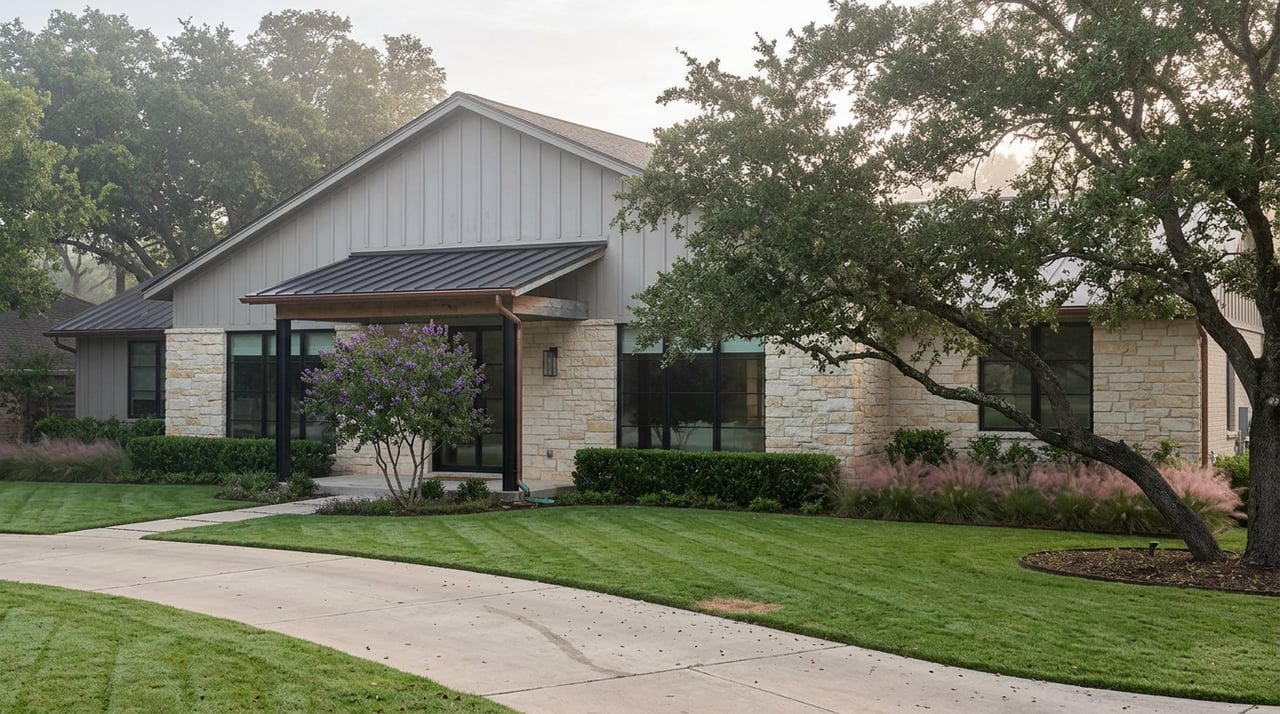
Drive the loop around Berry Creek Drive and you'll pass two neighborhoods that share a name and a golf course, but not much else on the tax bill. Berry Creek proper sits inside Georgetown ISD. A newer section called Berry Creek Highlands, on the same subdivision's footprint, falls under Jarrell ISD instead. Same brand. Same clubhouse view from certain fairways. Different school district, different special-district math, and as it turns out, a completely different tax trajectory over the past five years.
That split is the whole story. Buyers comparing Georgetown's master-planned communities have been told a tidy version of how Municipal Utility District taxes work: the rate starts high while the district repays construction bonds, then glides downward as the debt gets paid off. It's a comforting story, and it's only half true. The tax rolls tell a messier one, and it matters more the closer you get to signing a contract on new construction.
The Rate That's Supposed to Only Go Down
Here's what five years of published effective tax rates actually look like for three Georgetown communities, each carrying a MUD, each marketed as a master-planned neighborhood with resort-style amenities:
| Community | 2021 | 2022 | 2023 | 2024 | 2025 |
|---|---|---|---|---|---|
| Wolf Ranch | 2.7228% | 2.6132% | 2.4482% | 2.4691% | not available in current records |
| Berry Creek | 2.0729% | 1.9632% | 1.7982% | 1.8191% | 1.8174% |
| Berry Creek Highlands (Jarrell ISD) | 2.76% | 2.6542% | 2.4706% | 2.4816% | 2.4837% |
Read across any of those rows and you'll see the pattern the standard advice promises: a steep decline from 2021 into 2023, roughly a quarter to a half a percentage point of relief. On a $500,000 assessed value, that's the difference between a $13,614 annual bill and a $12,346 one for Wolf Ranch, real money back in a homeowner's pocket over two years.
Then look at 2024. Wolf Ranch's rate ticked back up, from 2.4482% to 2.4691%. Berry Creek Highlands did the same, climbing from 2.4706% to 2.4816% and again to 2.4837% in 2025. Only Berry Creek proper kept declining through 2025, landing at 1.8174%, nearly a full point below its Highlands neighbor despite sharing a subdivision name.
What Actually Moves The Rate
The mechanism nobody puts in the marketing brochure: a MUD's rate falls while it retires existing bonds, and rises again the moment the district's board issues new bonds to fund the next phase of construction. Wolf Ranch is still building. The district's own bond disclosure documents describe subdivisions still in active development, homes under construction, and vacant developed lots waiting for buyers as of late 2023. A district that's still platting new sections is a district that's still borrowing, and every new bond series resets the clock on part of the rate, even as older debt keeps amortizing in the background.
Wolf Ranch's Municipal Utility District taxes are structured to run for 25 years, according to the community's own HOA. That's the outer boundary. It's not a countdown that only moves in one direction between now and year 25.
Berry Creek, by contrast, finished most of its original build-out years ago. Its home base sections aren't issuing fresh bonds for new phases the way an active build-out like Wolf Ranch is, which is likely why its rate has kept sliding rather than bouncing. Berry Creek Highlands, the newer section under Jarrell ISD, is closer in age and build cycle to Wolf Ranch, and its rate behaves accordingly.
The takeaway for anyone comparing communities isn't "MUD taxes are bad" or "MUD taxes are fine." It's that a district's rate history tells you where it sits in its own construction and debt cycle, and a community still selling new phases is a community whose rate has more room to move upward before it moves back down.
The Same Neighborhood Name Can Sit In Two Jurisdictions
Berry Creek Highlands is the clearest illustration of a second trap: buyers assume a community's name maps to a single taxing picture. It doesn't always. Two homes both marketed under the Berry Creek name can be zoned to different school districts entirely, which means different ISD tax rates layered on top of whatever the MUD is doing. Georgetown ISD and Jarrell ISD don't set identical rates, and the boundary between them can run through a single subdivision rather than around it.
This isn't unique to Berry Creek. Cimarron Hills, the golf and country club community on Georgetown's east side, shows an even more layered version of the same problem. The neighborhood carries an ETJ designation plus a MUD plus a PID stacked on top of a mandatory country club social membership, which runs roughly $5,000 to join and about $295 a month at current rates, with higher tiers for golf access. Add to that a school zoning quirk: San Gabriel Elementary is zoned to Cimarron Hills but physically sits in Liberty Hill, and the district's own middle and high schools are Georgetown ISD campuses nearly 17 miles away. None of that shows up in a listing photo. It shows up in a tax bill and a school run.
The New District Nobody's Compared Yet
If Wolf Ranch and Berry Creek show what an established MUD looks like mid-cycle, Heirloom Georgetown is the freshest example of a special district being built from scratch right now. Georgetown City Council gave the 620-acre project initial approval on August 12, 2025, and followed with final approval, annexation into city limits, and creation of the Public Improvement District on August 26, 2025, according to Community Impact's reporting. Developer Columnar Investments plans up to 3,600 homes across single-family, townhome, and multifamily product, plus more than 200,000 square feet of commercial space anchored by a Trader Joe's, on land north of Ronald Reagan Boulevard and west of Williams Drive. As of that approval, the developer's own stated target for breaking ground was early 2026.
The financing structure matters here as much as the acreage. Heirloom isn't sitting in the extraterritorial jurisdiction the way Wolf Ranch's MUD does. It was annexed into the city at that same August 26 meeting, which means its special-district costs will run through a Public Improvement District rather than an independent MUD board. A PID assessment gets collected alongside the regular city tax bill and is tied to a defined infrastructure plan rather than an open-ended utility district with its own taxing authority. At the time of the August 26 approvals, Assistant City Manager Nick Woolery called the PID financing agreement the "most critical" step still ahead, meaning the actual assessment number for Heirloom homeowners had not been finalized when the land use approvals went through. Anyone comparing floor plans there should confirm whether that financing agreement has since been finalized, since the number wasn't public as of that meeting.
Worth noting for context: Georgetown's own city tax rate moved in the opposite direction for FY2026. The City Council adopted a $1.3 billion budget on September 9, 2025, that lowered the city rate to 35.3 cents per $100 valuation, down from 36.5 cents, according to Fox 7 Austin. Rising property values still meant the average homeowner saw a small increase in their actual bill. That's the baseline layer every Georgetown property carries before any MUD or PID gets added on top, and it's a reminder that a falling rate and a falling bill aren't the same thing.
What This Means If You're Comparing Communities
A few questions worth asking before you fall in love with a floor plan, based on what the tax records actually show:
- Ask for the district's rate history, not just this year's number. A single year tells you almost nothing about direction. Five years tells you whether the district is winding down debt or still issuing it.
- Ask whether the community is still selling new phases. Active construction usually means active bond issuance, which means the rate has more room to move before it settles.
- Confirm the school district by the specific address, not the community name. Georgetown ISD and Jarrell ISD sit inside neighborhoods that share branding, and the boundary isn't always where you'd guess.
- For anything in a Public Improvement District like Heirloom, ask whether the assessment schedule has been finalized. An approved land plan and a finalized PID financing agreement are two different milestones.
- Layer in mandatory HOA or club fees separately from tax rates. Cimarron Hills is the clearest case where the club membership costs more monthly than most homeowners expect once it's added to the MUD and PID stack.
A Few Common Questions
Does a MUD tax ever disappear completely? Wolf Ranch's MUD is structured as a 25-year tax according to the community's HOA, which gives it a defined outer limit. Some districts also convert to city-managed utility systems after annexation, at which point the separate MUD line goes away. Whether that happens on any given timeline depends on the district's bond schedule and its annexation status, which is worth confirming for a specific address rather than assuming.
Is a PID better than a MUD? Neither is inherently better. A MUD is an independent taxing entity with its own board and its own bond schedule, which is what allows a rate to rise again mid-cycle the way Wolf Ranch's did. A PID assessment runs through the city's own tax bill and is tied to a specific, usually finite, infrastructure plan, but the assessment isn't locked in until the financing agreement itself is finalized, which was still pending for Heirloom as of its August 2025 approvals.
Where do I find the actual rate for a specific address? Williamson County publishes tax rate worksheets by district on the Williamson County Tax Office site, which lists every MUD, road district, and PID by name and year. That's the primary source, not a marketing page.
If you're weighing a home in a Georgetown community that's still building versus one that's largely finished, the tax history is doing more work than the amenity map. Bryan Thomas Properties has spent years on the construction side of these communities before ever listing in them, and that's the lens worth bringing to a comparison like this one. Work With Bryan before you sign, not after the first tax bill lands.